Best TMT Bars for Commercial Buildings: A Complete Guide
Commercial Building TMT Bars
A key component of designing a durable and strong reinforced concrete structure is choosing the best TMT bars for commercial buildings. Different structural loads, spans, and design criteria may be included in commercial constructions like offices, shopping centers, hospitals, schools, hotels, and high-rise buildings. Therefore, the structural design, relevant standards, loading conditions, and the structural engineer’s suggestions should all be taken into consideration while choosing the proper TMT grade and reinforcement specification.
Since TMT bars offer the strength and ductility needed in reinforced concrete construction, they are frequently employed as structural reinforcement steel. But there’s more to choosing TMT bars for commercial buildings than just picking a grade based solely on strength. It is also necessary to take into account elements like ductility, bendability, weldability, concrete bonding, corrosion resistance, manufacturing uniformity, and project specifications.
Why TMT Bars Are Important for Commercial Buildings?
To manage various kinds of structural stresses, reinforced concrete blends steel reinforcement with concrete. While reinforcement steel helps in the building’s overall structural performance and assists with tensile stress resistance, concrete is strong in compression.
The reinforcement system for commercial projects needs to be designed with the building’s loads and structural layout in mind. The appropriate TMT bars for commercial buildings can help with a number of crucial building elements.
Structural Strength
Concrete components like beams, columns, slabs, and foundations are supported by TMT bars. These components’ mechanical qualities enable them to withstand the stresses brought on by the building’s design loads.
Load – Bearing Capacity
Depending on their purpose and structural design, commercial buildings can experience large dead loads, live loads, and other forces. Concrete members can support these loads as envisaged by the structural design with the help of appropriately specified reinforcement.
Concrete Reinforcement
Steel and Concrete reinforcement combine to create reinforced concrete members. Structural calculations and construction drawings are used to determine the bars’ location, diameter, spacing, and grade.
Ductility
Steel can bend before failing due to its ductility. Because it can offer a certain amount of deformation capacity when a structure is subjected to fluctuating or high loads, this feature is particularly relevant to structural design.
Crack Control
By distributing tensile loads, reinforcement helps in the prevention of concrete cracking. When fitted in accordance with the structural design, proper bar diameters and spacing can promote management of cracks.
Durability
A reinforced concrete structure’s long-term performance is influenced by a number of variables, including the quality of the concrete, the cover, the exposure to the environment, the detailing, and the quality of the reinforcement. A reinforcement system intended for long-lasting construction may use TMT bars with the right characteristics.
What Makes TMT Bars Suitable for Commercial Construction?
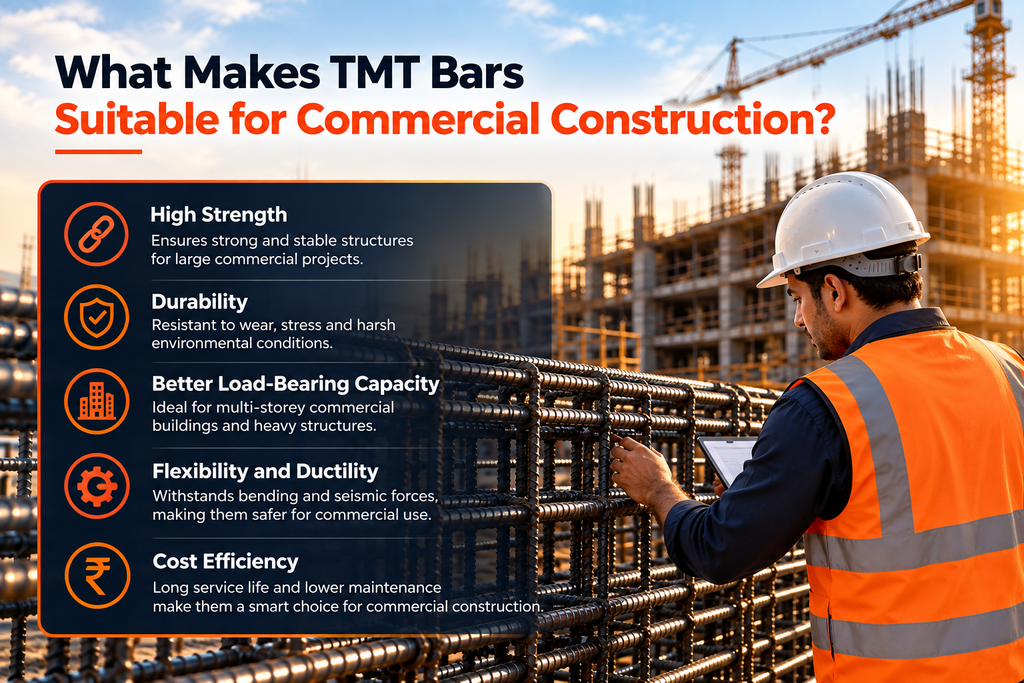
The mechanical characteristics, manufacturing quality, and project compatibility of TMT bars determine their appropriateness for commercial construction.
High Yield and Tensile Strength
Tensile strength is the highest stress a material can sustain before failing, whereas yield strength is the stress at which steel starts to experience substantial permanent deformation. Strength levels vary depending on the TMT grade.
Due to this, rather than just selecting the maximum strength available, the grade should be chosen based on structural calculations. Based on the building’s design and relevant parameters, the structural engineer will identify the necessary grade.
Ductility
One crucial feature of reinforcing steel is its ductility. Before failing, a ductile bar can experience significant deformation. When compared to their respective non-D grades, grades with the D designation such as Fe 500D and Fe 550D are linked to greater ductility requirements.
For TMT bars for commercial projects, ductility should be considered alongside yield strength and other mechanical properties.
Strong Bond with Concrete
A good bond between steel reinforcement and concrete allows forces to be transferred effectively between the two materials. The surface ribs on TMT bars increase the mechanical interaction between the reinforcement and surrounding concrete.
Proper bar placement, concrete compaction and adequate cover are also essential for achieving the intended structural performance.
Corrosion Resistance
When moisture and harsh climatic conditions get to the steel, reinforcement may be at danger for corrosion. The metallurgical characteristics of the bar can be influenced by TMT manufacturing procedures, and appropriate concrete cover and high-quality concrete offer extra protection.
Reinforcement parameters should take into consideration the expected exposure circumstances for projects in humid, coastal, or otherwise adverse areas.
Weldability and Bendability
Reinforcement bars must frequently be bent into exact forms during construction or, if allowed by the design and relevant regulations, welded together. Fabrication needs can be supported by appropriate mechanical qualities and chemical composition.
To prevent harming the reinforcement, bars should be bent and handled in accordance with project specifications and manufacturer recommendations.
Consistent Manufacturing Quality
When a lot of construction steel bars are needed, consistency is especially crucial. Maintaining uniformity in dimensions and mechanical qualities is made easier by controlled production procedures, suitable testing, and quality assurance.
The TMT bar manufacturer for commercial projects should be able to deliver goods that fulfill relevant standards and the project’s technical specifications.
Which TMT Grade Is Best for Commercial Buildings?
The right TMT grade for a commercial building depends on factors such as structural design, building height, load requirements, seismic considerations and the applicable construction specifications. Different grades offer different combinations of strength and ductility, so the grade should be selected according to the project’s engineering requirements.
Fe 500 TMT Bars for Commercial Buildings
Fe 500 TMT bars can be considered for commercial buildings where the structural design calls for this grade. They provide a practical combination of strength and ductility and may be suitable for commercial structures with standard load requirements. The final selection should always follow the structural engineer’s design.
Fe 500D TMT Bars for Commercial Buildings
Fe 500D offers higher ductility than standard Fe 500. This additional ductility can be valuable where the structure needs to accommodate greater deformation and dynamic or seismic forces. It may therefore be considered for commercial projects where ductility is an important design requirement.
Fe 550 TMT Bars for Commercial Buildings
Fe 550 provides higher yield strength than Fe 500, allowing structural designers to consider it for applications where higher-strength reinforcement is required. It can be used in residential and commercial construction where specified by the structural design and applicable standards.
Fe 550D TMT Bars for Commercial Buildings
Fe 550D combines higher strength with improved ductility compared with standard Fe 550. This combination can make it suitable for demanding structural applications where both load-bearing capacity and ductility are important. Its use should be determined by the project’s structural requirements.
Fe 600 TMT Bars for Commercial and Heavy Structures
Fe 600 offers a higher yield strength and can be considered for structures with demanding reinforcement requirements, including certain heavy-duty and high-load applications. However, higher-strength steel should not be selected simply because it has a higher grade. The appropriate grade must be confirmed through structural design and applicable specifications.
TMT Bar Grades for Commercial Buildings: Comparison
| TMT Grade | Key Characteristic | Potential Application |
| Fe 500 | High strength with established use | Commercial and general structural applications |
| Fe 500D | Higher ductility | Structures where ductility is an important design consideration |
| Fe 550 | Higher yield strength | Higher-load structural applications where specified |
| Fe 550D | Higher strength with higher ductility | Demanding commercial and structural applications |
| Fe 600 | Very high strength | Specialised/high-load applications where specified |
Which Commercial Buildings Use TMT Bars?
Numerous different types of commercial reinforced concrete constructions use TMT reinforcement. The structural design determines the exact grade and bar sizes.
Office Buildings
Multiple floors, vast open spaces, columns, beams, and slabs are all possible features of office buildings. The structural system, loads, spans, and building plan all influence the level of reinforcement needed.
Shopping Malls and Retail Complexes
Large floor plans, parking structures, and open spans are all possible in retail complexes. For commercial applications, TMT bars in Gujarat can be used in reinforced concrete components such as slabs, columns, beams, and foundations.
Hospitals
Since hospitals may have several levels, special rooms, equipment sections, and service spaces, they need structural systems that are carefully constructed. Structural engineering calculations are used to determine reinforcement parameters.
Schools and Educational Buildings
Reinforced concrete is used for slabs, beams, columns, and foundations in schools and other educational structures. The building’s intended purpose and structural requirements determine the reinforcement grade and dimensions.
Hotels
Large rooms, service areas, communal areas, and several rooms can all be found in hotels. Commercial buildings reinforcement systems may include TMT steel bars.
Multi-Storey Commercial Buildings
The importance of reinforcing design increases with building height and structural complexity. Before suggesting reinforcement, engineers assess loads, structural components, seismic considerations when appropriate, and other design elements.
Warehouses and Commercial Facilities
Wide spans and specific loading needs may be present in warehouses. Storage areas, workshops, and industrial support spaces are examples of commercial facilities that may need reinforcement depending on their intended use and structural layout.
How to Choose the Right TMT Bars for Commercial Buildings?
Selecting the right TMT bars for a commercial building involves more than simply choosing a higher grade. The reinforcement should match the structural design, concrete specifications, environmental conditions and project requirements. Consider the following factors before finalising TMT bars for a commercial construction project.
Structural Load Requirements
Commercial buildings may experience significant loads from floors, equipment, occupants and other structural elements. The TMT grade and reinforcement arrangement should therefore be selected according to the loads calculated in the structural design.
TMT Grade
Different TMT grades offer different levels of yield strength and ductility. Fe 500, Fe 500D, Fe 550, Fe 550D and Fe 600 may be considered for different applications, but the appropriate grade should be specified by the structural engineer based on project requirements.
Ductility
Ductility allows reinforcement steel to deform before failure. This can be particularly important in structures exposed to dynamic or seismic forces. Where required, a ductile grade such as Fe 500D or Fe 550D may be considered as part of the structural design.
Concrete and Steel Compatibility
TMT bars and concrete work together as a reinforced concrete system. The selected reinforcement should be compatible with the specified concrete grade, construction method and structural design to achieve the required performance.
Corrosion Resistance
Commercial buildings in coastal, humid or chemically aggressive environments may require greater attention to reinforcement durability. TMT bars with appropriate corrosion resistance and suitable concrete cover can help support long-term structural durability.
BIS Certification and Applicable Standards
Always check that the TMT bars meet the relevant BIS requirements and applicable Indian Standards. Compliance provides an important quality benchmark for reinforcement steel used in construction.
Bar Diameter and Reinforcement Design
TMT bars are available in different diameters, and the required diameter depends on the structural drawings and reinforcement design. Bar diameter should never be selected based only on availability or preference.
Manufacturing Quality
Consistent manufacturing is important for achieving reliable mechanical properties and dimensional accuracy. Look for manufacturers with established quality-control processes, testing facilities and consistent production standards.
Weight and Dimensional Accuracy
Accurate bar dimensions and consistent weight help contractors plan material requirements and reinforcement work more efficiently. Quality TMT bars should maintain consistency across batches and sizes.
Availability and Supply Capacity
Large commercial projects require a dependable supply of reinforcement steel throughout construction. Before selecting a TMT manufacturer, consider production capacity, stock availability, delivery timelines and the ability to supply the required grades and diameters consistently.
Why BIS Certification Matters for Commercial Construction?
For commercial construction, reinforcement steel needs to meet defined quality and performance requirements. BIS certification provides an important quality benchmark for TMT bars manufactured and supplied in India. Buyers should also verify the relevant certification and test documentation for the specific material being supplied.
IS 1786
IS 1786 specifies requirements for high-strength deformed steel bars and wires used for concrete reinforcement. It covers important properties such as chemical composition, mechanical performance, dimensions and testing requirements.
BIS Certification
BIS certification indicates that the manufacturer’s product has been assessed against the applicable Indian Standard. When purchasing TMT bars, project teams should verify the manufacturer’s certification details and ensure the supplied material matches the specified grade and standard.
Quality Testing
Quality testing helps confirm that TMT bars meet the required physical, mechanical and chemical specifications. Manufacturers may conduct testing during production and on finished products to maintain consistency between batches.
Chemical Composition
The chemical composition of steel affects important properties such as strength, ductility, weldability and overall performance. Testing helps verify that the material remains within the limits specified for the relevant grade and standard.
Tensile Strength
Tensile strength indicates the maximum stress a TMT bar can withstand during a tensile test before failure. It is an important mechanical property used to assess the performance of reinforcement steel.
Yield Strength
Yield strength indicates the stress at which the steel begins to undergo permanent deformation. TMT grades such as Fe 500, Fe 550 and Fe 600 are classified according to specified yield-strength requirements.
Elongation
Elongation indicates how much a TMT bar can stretch during a tensile test before breaking. It provides an indication of ductility, which is an important consideration when selecting reinforcement for structural applications.
Bend and Rebend Testing
Bend and rebend tests assess the ability of reinforcement bars to withstand bending and subsequent deformation without developing unacceptable cracks or failures. These tests are particularly relevant to the practical handling and fabrication of reinforcement on construction sites.
Dimensional Accuracy
Consistent diameter, mass and rib geometry are important for reinforcement design and construction. Dimensional checks help ensure that TMT bars conform to the applicable requirements and can be properly incorporated into the reinforcement system.
Role of TMT Manufacturing Technology in Commercial Construction
The characteristics of TMT reinforcement are mostly determined by the production process. The goal of thermomechanical treatment is to provide the bar both strength and ductility.
Controlled Heat Treatment
The hot-rolled bar is cooled under controlled conditions during TMT manufacture. The steel’s microstructure is impacted by this procedure, which also helps to achieve the required mechanical qualities.
Strong Outer Surface
The rapid cooling process produces a harder outer region in the bar. This contributes to the high strength associated with TMT reinforcement.
Ductile Inner Core
The bar’s internal structure is still relatively softer and more flexible. Strength and ductility are balanced by the combination of the outer area and inner core.
Consistent Mechanical Properties
Achieving similar mechanical qualities across batches requires controlled manufacturing and quality testing. Consistency can assist engineers and contractors in working with reinforcement that satisfies the standards for major commercial construction projects.
Quality Tests for TMT Bars Used in Commercial Buildings
Quality testing helps verify that TMT bars meet the required mechanical, chemical and dimensional specifications before they are used in a commercial building. These tests help ensure consistency, strength and suitability for the intended structural application.
Tensile Strength Test
The tensile strength test measures the maximum stress a TMT bar can withstand when pulled until failure. It helps assess the overall strength and performance of the reinforcement steel.
Yield Strength Test
The yield strength test determines the stress at which a TMT bar begins to deform permanently. This is an important property used to classify reinforcement grades such as Fe 500, Fe 550 and Fe 600.
Elongation Test
The elongation test measures how much the TMT bar stretches before breaking. Higher elongation generally indicates greater ductility, which can be important where reinforcement needs to accommodate deformation.
Bend Test
The bend test checks whether a TMT bar can be bent through the specified angle without developing unacceptable cracks or other defects. It helps assess the bar’s ductility and suitability for fabrication during construction.
Chemical Composition Test
Chemical analysis checks the proportions of elements present in the steel. Controlling chemical composition helps achieve the required balance of strength, ductility, weldability and other material properties.
Dimensional and Weight Checks
TMT bars are checked for dimensions, mass and rib characteristics to ensure consistency with applicable requirements. Accurate dimensions and weight are important for reinforcement detailing, material estimation and proper placement at the construction site.
Why Choose BHRATA TMX TMT Bars for Commercial Projects?
Choosing a TMT bar manufacturer is an important decision for commercial construction projects, where consistent quality, suitable grades and dependable supply are essential. BHRATA TMX offers TMT bars for residential, commercial, industrial and infrastructure applications, with a focus on manufacturing quality and product consistency.
TMT Bars for Commercial and Industrial Construction
BHRATA TMX TMT bars are positioned for a range of construction applications, including commercial buildings, industrial structures and other projects requiring reliable reinforcement. Its Fe 550 range is specifically presented for residential and commercial construction, while higher-strength grades are available for more demanding applications.
Advanced Manufacturing Technology
BHRATA TMX uses advanced manufacturing technology to produce TMT bars with a combination of strength and ductility. The company states that its manufacturing process is designed to support consistent product performance across different construction requirements.
Quality Inspection
Quality inspection is an important part of BHRATA TMX’s manufacturing approach. The company highlights regular quality checks and testing of properties such as tensile strength, chemical composition and dimensional accuracy to maintain consistency in its TMT bars.
BIS-Focused Quality Compliance
BHRATA TMX highlights compliance with applicable BIS requirements as part of its quality approach. Buyers should verify the relevant certification and test documentation for the specific grade and material supplied for their project.
Multiple TMT Grades
BHRATA TMX offers grades including Fe 550, Fe 550D and Fe 600, allowing project teams to consider different reinforcement options based on structural design and applicable specifications. Fe 550 is positioned for residential and commercial applications, while Fe 550D and Fe 600 are presented for more demanding structural requirements.
Distribution and Dealer Network
A reliable supply chain is important for commercial projects because delays in reinforcement supply can affect construction schedules. BHRATA TMX highlights its dealer network and expanding market presence to support product availability across Gujarat.
Supply Across Gujarat
BHRATA TMX is based in Mehsana, Gujarat, and states that it supplies TMT bars for construction requirements across Gujarat. For commercial projects, buyers can discuss required grades, diameters, quantities and delivery schedules with the company or its authorised distribution network.
Frequently Asked Questions
Q1. Which TMT bar is best for commercial buildings?
No single TMT grade is appropriate for every type of commercial building. Structural design, loading circumstances, relevant standards, environmental considerations, and project specifications all influence selection.
Q2. Is Fe 550 suitable for commercial buildings?
Since Fe 550 has a higher yield strength and satisfies structural design criteria, it might be appropriate for commercial structures. Engineering calculations and relevant standards should be used to determine the final grade.
Q3. Is Fe 500D suitable for commercial construction?
When Fe 500D’s strength and ductility satisfy project requirements, it can be used in a variety of commercial construction applications. Whether it is suitable for the particular building should be decided by the structural engineer.
Q4. What is the difference between Fe 500D and Fe 550D?
The primary difference between Fe 500D and Fe 550D is the specified yield strength. Both Fe 500D and Fe 550D offer greater ductility, with minimum yield strengths of 500 MPa and 550 MPa, respectively.
Q5. Which TMT grade is suitable for high-rise commercial buildings?
There is no single TMT grade that is suitable for every high-rise building. The required grade depends on the structural design, loads, seismic considerations and applicable specifications. Grades such as Fe 500D, Fe 550D or higher-strength grades may be considered where specified by the structural engineer.
Q6. Why is ductility important in commercial buildings?
Ductility allows TMT reinforcement to deform and absorb energy before failure. This can be particularly important in high-rise and commercial structures that may experience dynamic or seismic forces. Ductile grades such as Fe 500D and Fe 550D can be considered when the structural design requires these properties.
Q7. How do I verify the quality of TMT bars?
Check the manufacturer’s BIS certification, test certificates and relevant product documentation. You can also review properties such as yield strength, tensile strength, elongation, chemical composition, dimensions and weight to confirm that the supplied bars meet the specified requirements.
Q8. What certifications should I check before buying TMT bars?
For TMT reinforcement steel in India, check compliance with the applicable BIS requirements, particularly IS 1786 for high-strength deformed steel bars and wires used for concrete reinforcement. Also verify the manufacturer’s certification details and test certificates for the specific grade and batch where applicable.
Choose the Right TMT Bars for Your Commercial Project
Planning a commercial construction project? Share your project requirements with us to discuss suitable TMT bar grades, sizes, and availability and supply requirements. Our team can help you understand the available options based on your structural specifications and construction needs, supporting informed material selection for reliable project planning, procurement and execution.